What a Fatigue Risk Management System Sees That Standard Monitoring Misses

An incident is not an event. It is the last stage of a process, and the four stages before it are all measurable. Standard monitoring captures the final stage and misses the other four, which is the same as missing all of them, because by the last stage it is too late to act.
That is the whole problem in one sentence. An incident report describes a single moment: a missed signal, a delayed response, a judgement that turned out wrong. The moment is real. It is also the least useful part of the story, because it is the end of something that ran for weeks. Standard monitoring sees the moment. A fatigue risk management system sees the process.
Here is what that process looks like, stage by stage.
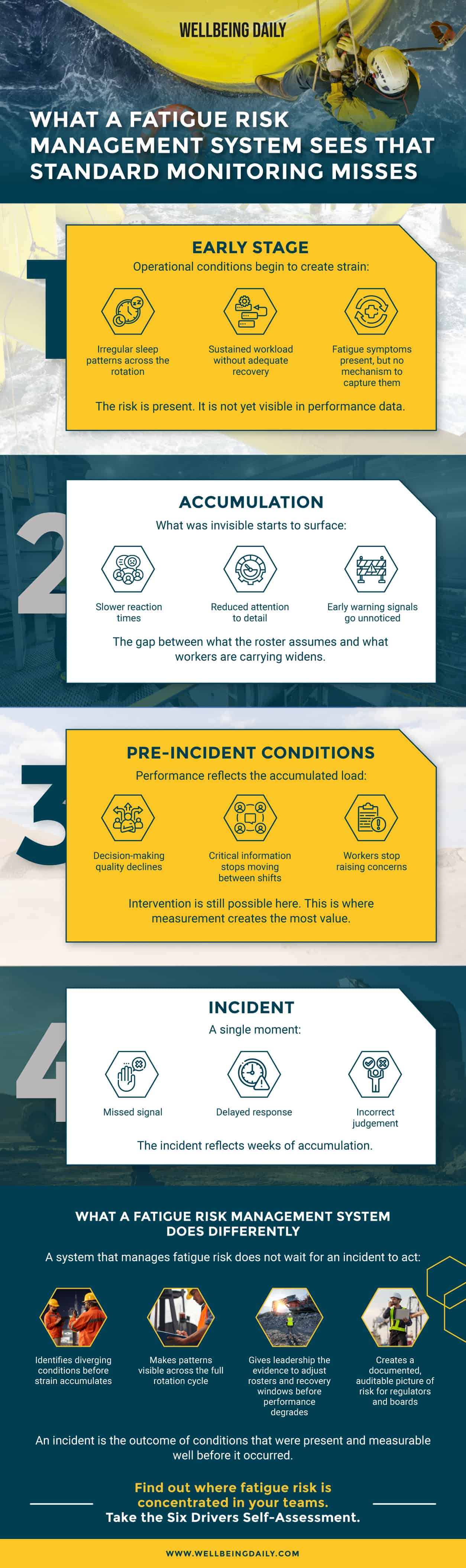
Stage One: Early Stage
Operational conditions begin to create strain before anything shows in performance data. Irregular sleep patterns build across the rotation. Workload runs sustained without adequate recovery. Fatigue symptoms are present, but there is no mechanism in place to capture them.
The risk is real at this stage. It is simply not yet visible. A dashboard built on outcomes shows nothing, because nothing has gone wrong yet. This is the cheapest point to intervene and the one standard monitoring is blindest to.
Stage Two: Accumulation
What was invisible starts to surface. Reaction times slow. Attention to detail drops. Early warning signals begin to go unnoticed, which is its own kind of warning.
The gap between what the roster assumes and what workers are actually carrying widens. The plan still describes a rested crew. The crew is no longer that crew. Nothing here is dramatic enough to trigger an incident, so a standard system stays quiet. The condition, though, is now measurable for anyone looking at the right indicators.
Stage Three: Pre-Incident Conditions
Performance now reflects the accumulated load. Decision-making quality declines. Critical information stops moving cleanly between shifts. And workers stop raising concerns, which removes the last informal warning the system had.
This is the most important stage, because intervention is still possible here. The incident has not happened. The conditions that would cause it are fully present and fully visible to a system built to see them. This is where measurement creates the most value, and where standard monitoring, waiting for an outcome, still shows nothing.
Stage Four: The Incident
A single moment. A missed signal, a delayed response, an incorrect judgement. The report will treat it as the event. It is not the event. The incident reflects weeks of accumulation that were present and measurable at every prior stage.
This is the only stage standard monitoring reliably captures. By definition, it captures it too late.

What a Fatigue Risk Management System Does Differently
A system that manages fatigue risk does not wait for an incident to act. That is the whole distinction. It works at the stages standard monitoring cannot see.
It identifies diverging conditions before strain accumulates, at stage one, while intervention is cheapest. It makes patterns visible across the full rotation cycle, not just at the point of failure. It gives leadership the evidence to adjust rosters and recovery windows before performance degrades, rather than after an investigation recommends it. And it creates a documented, auditable picture of risk for regulators and boards, which awareness programmes and injury counts cannot provide.
This connects directly to how psychosocial risk is framed under ISO 45003, and to how a psychosocial risk assessment shows up in day-to-day operations. Fatigue is not a personal failing to be trained away. It is a design condition that the organisation is responsible for identifying and controlling, across rosters, rotation length, and recovery.
The Six Drivers framework is how that responsibility gets operationalised. It identifies where fatigue conditions are developing before they reach incident data, and three of the drivers are directly activated by fatigue: Work Design and Demands, Leadership and Relationships, and Culture and Safety.
Why the Stages Matter More Than the Incident
The value of seeing the process is that every stage before the incident is an intervention point. Miss stage one and you can still act at stage two. Miss stage two and stage three is still open. Only at stage four does the window close, and standard monitoring operates almost entirely at stage four.
In maritime, mining, and oil and gas, the difference between acting at stage two and reacting at stage four is measured in downtime, turnover, and regulatory exposure. The stages look the same in each sector, but fatigue behaves differently across the three, and where the accumulation bites hardest changes with the environment. It is also, often, measured in outcomes that a stage-two intervention would have prevented outright.
The Honest Position
A fatigue risk management system does not remove fatigue. Long rotations and sustained demand are structural features of high-risk work, and no system changes that. What it changes is when you find out. Weeks early, while the conditions are still adjustable, or on the day of the incident, when they are not.
An incident is the outcome of conditions that were present and measurable well before it occurred. The only question is whether anyone was measuring them. That is what wellbeing looks like when it is treated as operational intelligence rather than an HR initiative.
Frequently asked questions
What is a fatigue risk management system?
It is a structured way of identifying and controlling the conditions that produce fatigue, tracked across the full rotation cycle rather than measured only at the point of an incident. It works on leading indicators, which lets an organisation act while intervention is still possible.
How is it different from standard safety monitoring?
Standard monitoring reports outcomes: incidents, injuries, lost time. These only register at the final stage, after the risk has already caused harm. A fatigue risk management system makes the earlier stages visible, when conditions are diverging but no incident has yet occurred.
At which stage should we intervene?
As early as possible. Stage one is cheapest, but stages two and three are still open windows. The point of the model is that intervention remains possible right up until the incident. Standard monitoring simply cannot see those windows, so organisations relying on it default to acting at stage four.
Does a fatigue risk management system help with regulatory compliance?
Yes. It produces a documented, auditable picture of how you identified and controlled fatigue risk over time, which is what regulators and insurers increasingly expect under frameworks like ISO 45003. Awareness programmes and injury statistics do not provide that evidence.
How does this connect to the Six Drivers?
The Six Drivers framework identifies where fatigue conditions are developing before they reach incident data. Three drivers in particular are directly activated by fatigue: Work Design and Demands, Leadership and Relationships, and Culture and Safety. Measuring against them shows where in your teams that risk is concentrating.