How Fatigue Behaves Differently Across High-Risk Environments

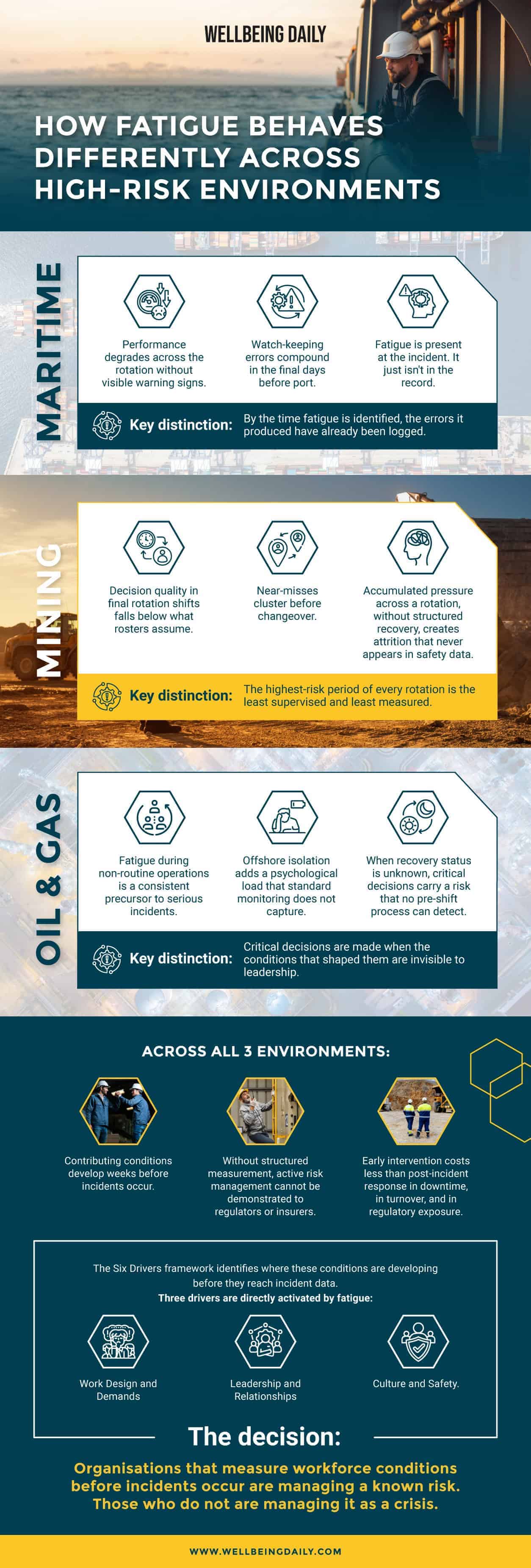
Three operations. Three fatigue problems that look the same on a roster and behave nothing alike in practice.
A watchkeeper's error compounds in the last days before port. A mining crew's decision quality falls in the final rotation shift, exactly when supervision is thinnest. An offshore operator makes a critical call while carrying a recovery deficit no pre-shift check could see.
Same underlying condition. Three different failure modes. Manage them as one generic problem and you miss the specific way each one bites.
Fatigue Is Not a Single Problem
There is a habit in safety of treating fatigue as one thing: tiredness, fixed with a rest break and a caffeine policy. That framing is comfortable and wrong. Fatigue is a design problem, shaped by rosters, rotation length, workload, and recovery access. Change the operating environment and you change how the design fails.
What holds across every high-risk sector is the timing. Fatigue is present at the moment of the incident, but the conditions that produced it were present for weeks. The record captures the moment. It rarely captures the accumulation. That is the pattern worth understanding, and it looks different in each sector.
Maritime: The Errors Are Already Logged
At sea, performance degrades across a rotation without a visible warning sign. There is no alarm for accumulated fatigue. A watchkeeper does not feel a threshold cross.
Watch-keeping errors compound in the final days before port, when demand rises and reserve is lowest. And here is the distinction that matters: by the time fatigue is formally identified, the errors it produced have already been logged. Fatigue is present at the incident. It just is not in the record as a cause.
In maritime operations, the problem is not that fatigue is invisible. It is that the system only names it after it has already shaped the outcome.
Mining: The Highest-Risk Period Is the Least Watched
In mining, decision quality in the final rotation shifts falls below what the roster assumes. The roster is a plan built on a rested worker. The final shift is worked by a different person, physiologically, than the one the plan imagined.
Near-misses cluster before changeover, in the run-up to the handover, when accumulated pressure across the rotation is at its peak. And that accumulated pressure, without structured recovery, creates attrition that never appears in safety data at all. People leave, or quietly disengage, and nothing in the incident record explains why.
The distinction here is sharp. The highest-risk period of every rotation is the least supervised and the least measured. The plan assumes the opposite.
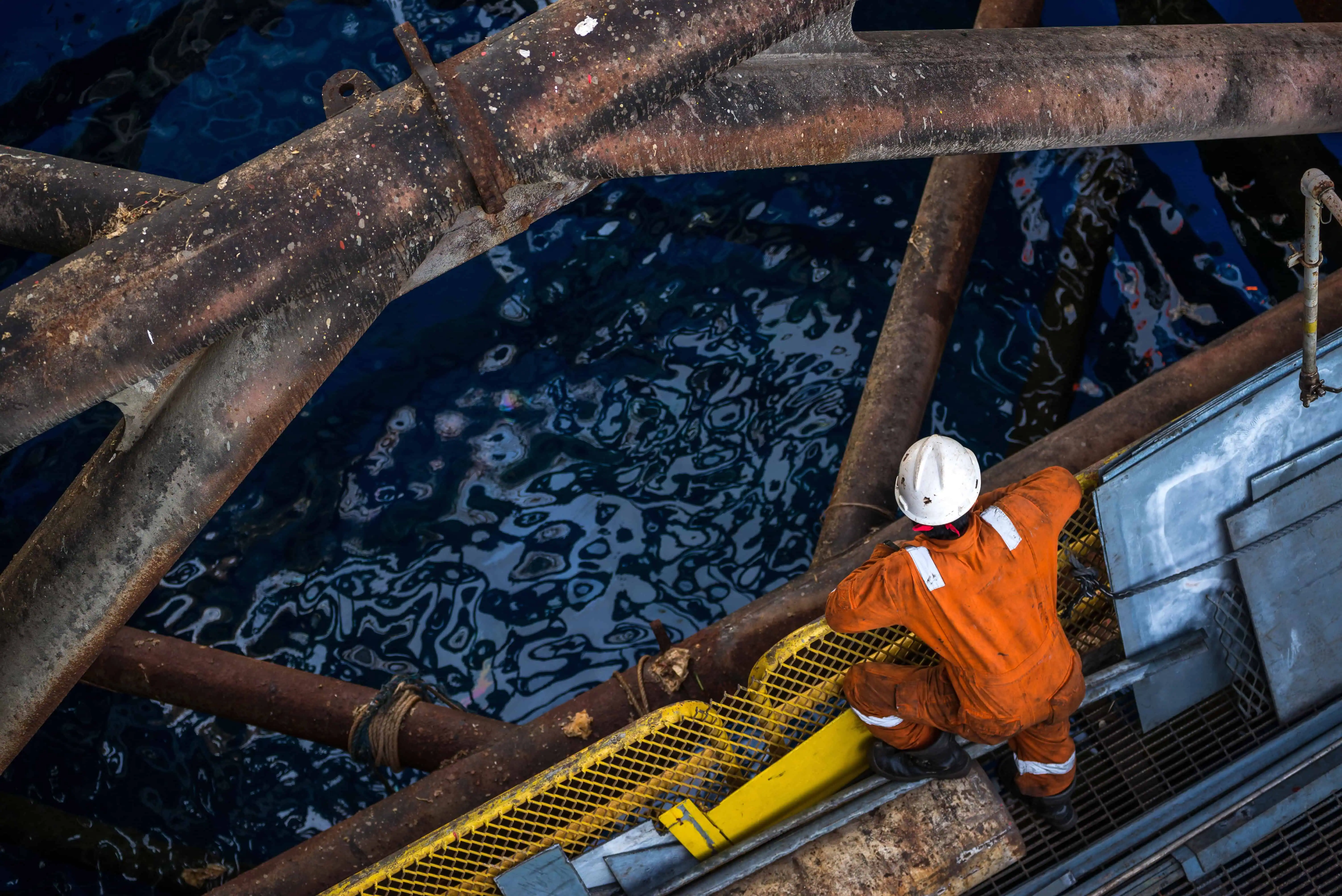
Oil and Gas: Decisions Made in the Dark
In oil and gas, fatigue during non-routine operations is a consistent precursor to serious incidents. Non-routine is exactly when the margin between demand and resource is thinnest, and exactly when a tired operator has the least to give.
Offshore isolation adds a psychological load that standard monitoring does not capture. And when recovery status is unknown, a critical decision carries a risk that no pre-shift process can detect. A pre-shift check confirms a person is present. It does not reveal what they are carrying.
The distinction: critical decisions get made when the conditions that shaped them are invisible to leadership. The people deciding cannot see the load, and neither can the people responsible for the system.
What Holds True Across All Three
Strip away the sector detail and the same three facts remain.
Contributing conditions develop weeks before an incident occurs. Without structured measurement, active risk management cannot be demonstrated to regulators or insurers, because you have no evidence of the conditions you were managing. And early intervention costs less than post-incident response, in downtime, in turnover, and in regulatory exposure.
The Six Drivers framework identifies where these conditions are developing before they reach incident data. Three of the drivers are directly activated by fatigue: Work Design and Demands, Leadership and Relationships, and Culture and Safety. Fatigue degrades roster viability, erodes the early raising of concerns, and dulls the system's response to weak signals. Those three drivers are where it shows up first.

Measuring the Difference
The practical response is not a single fatigue policy applied everywhere. It is measurement tuned to how each environment actually fails. Maritime needs a read on the back end of the rotation. Mining needs eyes on the pre-changeover window. Oil and gas needs recovery status made visible before a non-routine decision, not after.
None of this shows up in injury counts. It shows up in leading indicators tracked at the rotation and team level, where the accumulation is happening.
The Decision
Fatigue will not be engineered out of high-risk work. Long rotations, isolation, and sustained demand are structural features of these industries, not faults to be removed. What can change is whether the risk is a known quantity or a hidden one.
Organisations that measure workforce conditions before incidents occur are managing a known risk. Those who do not are managing it as a crisis. The conditions are the same in both cases. The only difference is whether anyone was looking in time.

Frequently asked questions
Why does fatigue need to be managed differently in each sector?
Because the operating environment shapes how fatigue fails. Maritime concentrates risk in the final days before port, mining in the pre-changeover window, and oil and gas in non-routine decisions under isolation. A single generic policy misses the specific point at which each environment breaks down.
If fatigue is present at most incidents, why does it rarely appear in the record?
Because the record captures the moment of the incident, not the weeks of accumulation that preceded it. Fatigue shapes the error, but by the time it is formally identified, the error has already been logged under a different cause. This is why leading measurement matters more than incident analysis alone.
Which of the Six Drivers are most affected by fatigue?
Work Design and Demands, Leadership and Relationships, and Culture and Safety. Fatigue undermines roster viability, suppresses the early raising of concerns, and weakens how quickly a system responds to a warning signal. These three are where fatigue shows up before it reaches incident data.
Can early intervention really cost less than responding after an incident?
Yes. Post-incident response carries downtime, turnover, and regulatory exposure that early intervention avoids. The condition is measurable well before it becomes an incident, and acting at that stage is consistently cheaper than acting after.
How do we demonstrate fatigue risk management to a regulator?
With structured measurement of the conditions, tracked over time. Without it, you can describe your intent but cannot evidence your management. Regulators and insurers increasingly expect a documented, auditable picture of the risk, not just a record of your response once something has gone wrong.