How Psychosocial Risk Assessment Shows Up in Operations

A ship's officer misses a handover detail after four rotations with no proper recovery. A shift supervisor sits on a growing concern for two weeks because raising it never felt safe. A crew member's decision quality slips on hour eleven of a shift that was never designed for eleven hours.
None of these get logged as psychosocial risk. They get logged as human error, if they get logged at all.
ISO 45003 exists because that gap between what actually happens and what gets recorded is where most safety-critical organisations are losing visibility. The standard frames psychosocial risk as a system design issue, not an individual one. Organisations are required to identify, assess, and control the conditions that produce it, not just respond after someone burns out or a near-miss forces the conversation.
The question most operations leaders ask next is a fair one: what does that actually look like on the ground?
Where the Conditions Actually Live
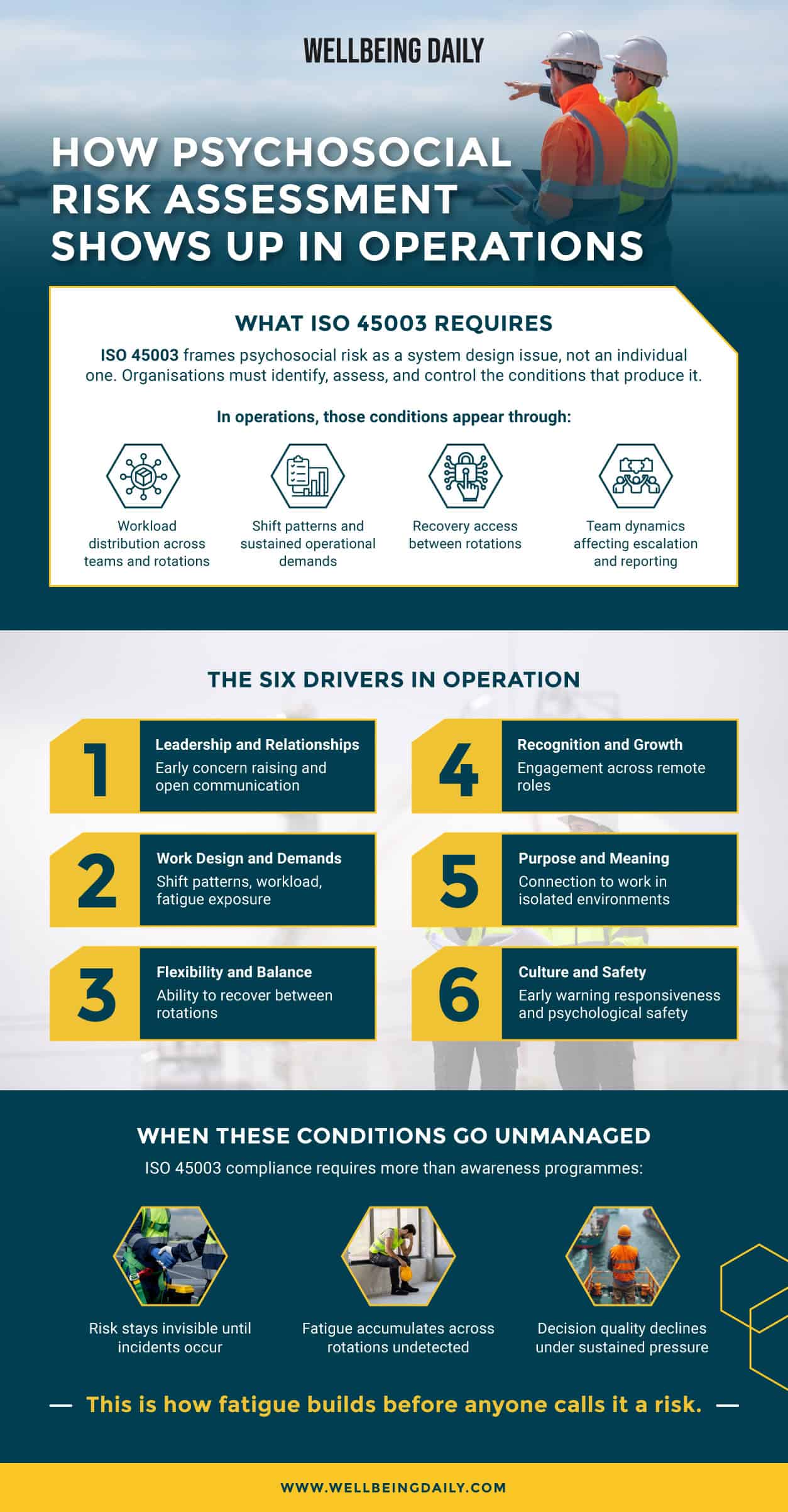
ISO 45003 compliance isn't a policy document sitting in a folder. In real operations, the conditions it asks you to assess show up in four places.
Workload distribution across teams and rotations is the first. Two teams can carry identical headcounts and produce very different fatigue profiles, depending on how work gets allocated within the roster. Shift patterns and sustained operational demands are the second. A pattern that looks compliant on paper can still stack recovery deficits across consecutive rotations if the sequencing isn't examined closely.
Recovery access between rotations is the third, and it's often the most overlooked. Having time off scheduled isn't the same as having genuine recovery available, particularly in remote or FIFO environments where the gap between shifts gets consumed by logistics, isolation, or disrupted sleep. Team dynamics affecting escalation and reporting are the fourth. If people don't feel safe raising a concern early, risk stays invisible until it surfaces as an incident.
These four conditions aren't abstract. They're the operational reality ISO 45003 is asking organisations to assess directly, using the same rigour applied to physical hazards.
The Six Drivers in Operation
We use six drivers to structure how these conditions get assessed and tracked across a workforce.
Leadership and relationships cover how early a concern gets raised, and whether communication stays open before a small issue becomes a bigger one. Work design and demands cover the mechanics of shift patterns, workload, and fatigue exposure, the structural side of the risk. Flexibility and balance track something narrower but critical: the actual ability to recover between rotations, not just the scheduled time to do so.
Recognition and growth matter more in remote and distributed roles than they often get credit for. Engagement drops fastest where people feel disconnected from progress or purpose, and that drop shows up in decision quality long before it shows up in a resignation. Purpose and meaning track connection to the work itself, particularly in isolated environments where that connection is harder to sustain. Culture and safety close the loop, covering how responsive the system is to early warnings and whether psychological safety exists in practice, not just in policy.
Together, these six drivers give a workforce-level picture of where psychosocial risk is concentrating, before it becomes an incident statistic.

What Happens When These Conditions Go Unmanaged
ISO 45003 compliance requires more than an awareness programme, because the consequences of unmanaged psychosocial risk don't announce themselves early.
Risk stays invisible until incidents occur. Without proper assessment, there's no early indicator to act on, only a lagging one. Fatigue accumulates across rotations undetected, because a single shift can look fine in isolation while the cumulative pattern across a month tells a very different story. Decision quality declines under sustained pressure, quietly and progressively, well before anyone involved would describe themselves as impaired.
This is how fatigue builds before anyone calls it a risk. By the time it's visible in incident data, the conditions that produced it have usually been in place for weeks or months.
Assessment as Operational Intelligence
The organisations getting this right aren't treating ISO 45003 as a compliance exercise to complete once a year. They're treating psychosocial risk assessment the same way they treat any other operational risk category, as something to be measured continuously, tied to specific conditions, and acted on before it shows up in the numbers that matter: incident rates, retention, and performance capacity.
That shift, from awareness to assessment, from individual responsibility to system design, is the difference between a wellbeing programme that feels good and one that actually holds up when conditions get hard.