HOP and Workforce Wellbeing: One Workforce, Two Disciplines

On the second floor, a safety team is reviewing a serious near-miss. They are asking about conditions: the workload the crew was carrying, the pressure that shift, the state of the equipment, the decisions that led to a worker being where they should not have been. On the third floor, an HR team is reviewing engagement scores. They are talking about the same crew, but the vocabulary is entirely different. Wellbeing. Burnout. Retention risk. Neither meeting mentions the other.
Two disciplines have shaped serious thinking about people at work over the last decade. Human and Organisational Performance (HOP) has changed how safety leaders understand incidents, error, and capacity. Workforce wellbeing has changed how organisations think about the conditions that let people perform sustainably. Both disciplines are pointing at the same underlying reality. They have rarely spoken to each other.
This article makes the connection explicit. It sets out what HOP actually is, where it converges with workforce wellbeing, and why treating the two as separate conversations produces weaker safety, weaker wellbeing, and a workforce that neither discipline sees clearly.
A Note on Language: Wellness or Wellbeing
The distinction matters here more than in most contexts, because HOP and wellness are philosophically incompatible. Wellness is a worker-deficiency model: the worker needs to be fitter, better rested, more resilient, better at managing stress. HOP starts from the opposite assumption. People are the solution, not the problem. What produces harm is the system, and the response is to change conditions, not workers. Workforce wellbeing, correctly understood, sits inside the same worldview. It treats performance capacity as a function of conditions, not character. That is why HOP and wellbeing belong in the same conversation, and why HOP and wellness never will.
What HOP Actually Is
Human and Organisational Performance is a philosophy and set of operating principles for how organisations understand people, work, and error. It emerged from decades of research into high-consequence industries: aviation, nuclear, offshore, healthcare. Its most cited voices are Todd Conklin (Pre-Accident Investigations, The 5 Principles of Human Performance), Sidney Dekker (The Field Guide to Understanding Human Error, Drift into Failure), and Rob Fisher of Fisher Improvement Technologies, whose work has translated the philosophy into operational practice across the energy and resources sectors.
The core of HOP is a small number of principles that redirect how organisations respond to failure and success.
Error is normal. Even good people make mistakes. Trying to eliminate error through effort, discipline, or punishment does not work, because error is a feature of human cognition under load, not a character flaw.
Blame fixes nothing. Punishing individual workers after an incident produces silence and defensiveness, not learning. Organisations that blame get worse data, not better behaviour.
Systems drives behaviour. What people do at work is a product of the conditions they are working in: workload, tooling, supervision, culture, fatigue. Behaviour follows context far more than it follows intent.
Learning is essential. The organisations that get safer are the ones that learn from normal work and from failure alike. Learning is an operational discipline, not an event.
How leaders respond matters. The single most important variable in whether a workforce raises concerns, reports near-misses, and talks honestly about pressure is how leaders respond when they do. Every leader response is a training event for the workforce.
These principles reframe safety from a compliance discipline into a learning discipline. They also, quietly, reframe how the organisation thinks about its workforce.
How HOP Differs from Human Factors Engineering
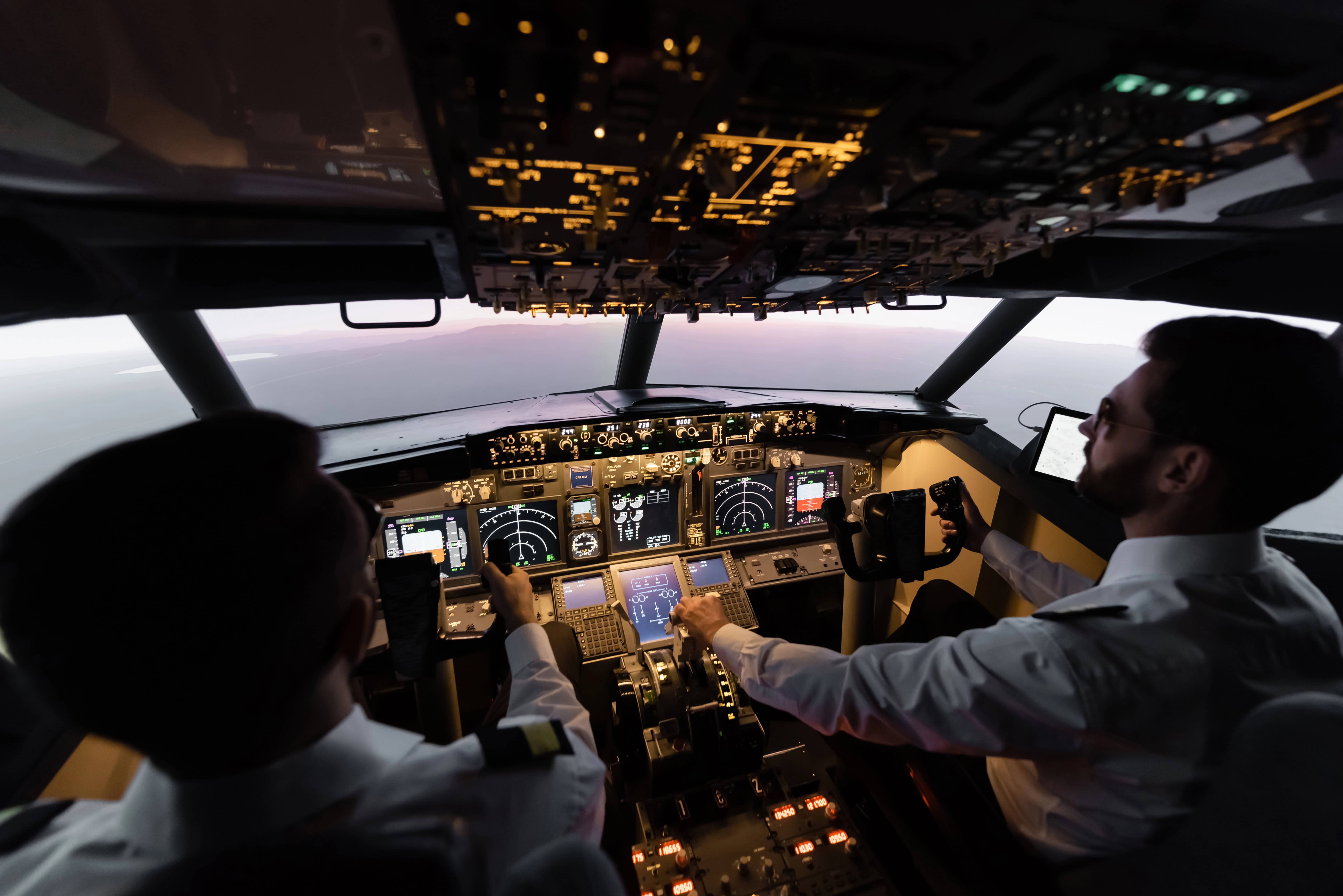
The two are frequently confused. They are related but distinct. Human Factors Engineering is a design discipline, focused on how tools, interfaces, workflows, and environments can be built to fit human capability. Its roots are in cockpit design, medical device design, and industrial ergonomics. It asks: how do we design the system so that human performance is supported?
HOP is broader. It asks: how does the organisation learn about the way work actually happens, how does it respond to failure, and how does leadership shape the conditions people work in? HFE tends to produce interventions in design. HOP tends to produce interventions in how the organisation learns and how leaders behave. Both matter. Neither replaces the other. A serious operation needs both.
Where HOP and Workforce Wellbeing Actually Converge
Once you look at the principles side by side, the overlap between HOP and workforce wellbeing is substantial.
Both treat the worker as a variable in a system, not as the source of the problem. Both reject the deficiency model that dominated the previous era of both safety and wellness thinking. Both recognise that conditions of work (roster patterns, workload, supervisor behaviour, psychological safety, cognitive load) produce outcomes, whether those outcomes are recorded as incidents or as burnout. Both understand that leadership behaviour is the single most concentrated lever in the system.
The similarity runs deeper than shared vocabulary. Sidney Dekker's academic work on drift, complexity, and human error sits directly upstream of the ISO 45003:2021 framework for psychosocial risk management. Rob Fisher's operational applications of HOP consistently identify psychological safety, fatigue, and leadership capability as core system conditions. Todd Conklin's insistence that safety is the presence of capacity rather than the absence of accidents is, in a slightly different vocabulary, precisely the argument that workforce wellbeing has been trying to make to boards for a decade.
Why the Two Disciplines Have Been Kept Separate
The separation is not intellectual. It is organisational.
HOP tends to live inside the safety and HSE function. It reports to a Chief Safety Officer or Head of HSE, sits alongside incident analysis and process safety, and speaks the language of controls, hazards, and learning teams. Its budget comes out of the safety envelope.
Workforce wellbeing tends to live inside HR. It reports to a Chief People Officer or Head of HR, sits alongside engagement, benefits, and culture programmes, and speaks the language of employee experience, retention, and burnout. Its budget comes out of the people envelope.
Two functions. Two vocabularies. Two sets of reports. One workforce. The result is that most organisations have neither a genuinely HOP-informed safety system nor a genuinely operational wellbeing system. What they have is two partial views of the same crew, with neither view seeing the full picture.
The cost of the separation is not abstract. Fatigue-related incidents get investigated as safety failures without reference to the roster patterns HR is measuring against engagement. Burnout gets treated as an HR issue without reference to the workload trends safety is measuring against near-miss rates. Supervisor behaviour, which shapes both, gets addressed twice through different training programmes with different vocabularies. The workforce ends up managing two disconnected conversations about themselves.
Wellbeing as Operational Intelligence
The reframe that closes the gap is straightforward. Workforce wellbeing is not a wellness programme. It is operational intelligence. It is a real-time read on the conditions the workforce is actually working in and the capacity they have available to respond to variability, failure, and pressure.
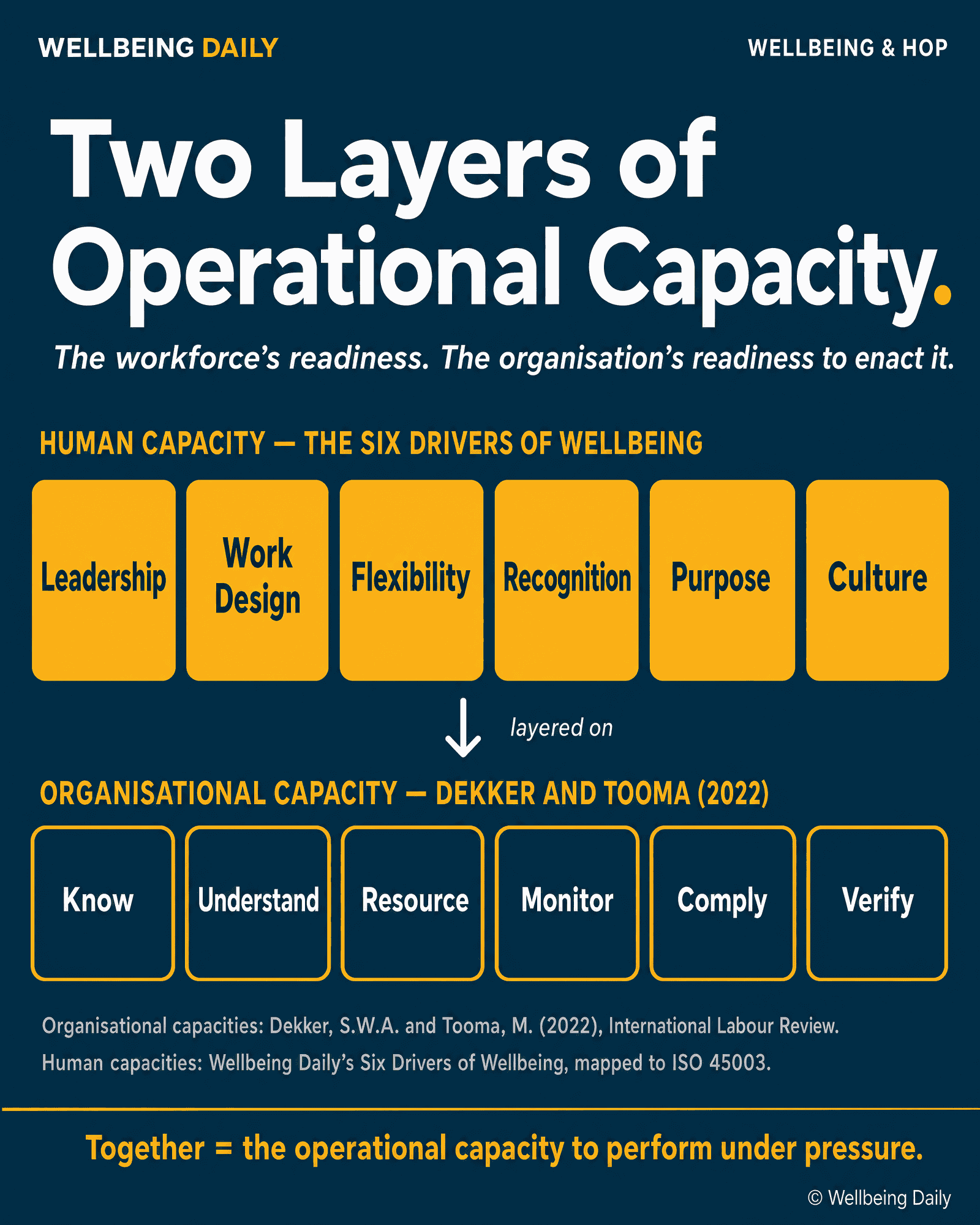
This is where the academic groundwork done by HOP thinkers becomes directly applicable. Dekker and Tooma's 2022 paper in the International Labour Review argued that traditional incident-based safety metrics (TRIR, LTIFR, and similar) are statistically flawed indicators of underlying safety performance, and proposed replacing them with a capacity index: a composite measure of an organisation's ability to absorb variability and recover from failure. Their organisational capacity model rests on six capacities: to know, to understand, to resource, to monitor, to comply, and to verify.
What Dekker and Tooma leave open is the human layer. Their six capacities describe what the organisation can do. They do not describe the condition of the workforce carrying out those capacities. That is where workforce wellbeing enters the picture. The Six Drivers framework used by Wellbeing Daily (Leadership and Relationships, Work Design and Demands, Flexibility and Balance, Recognition and Growth, Purpose and Meaning, Culture and Safety) operationalises the human capacity layer that sits beneath the organisational one. Layered together, they produce a two-part measure of operational capacity: the system's readiness, and the workforce's readiness to enact it.
This is what an HOP-informed workforce wellbeing strategy actually looks like. Not a wellness app bolted onto a safety management system. A coherent view of capacity that safety leaders and HR leaders can both use.
What This Looks Like in Practice
The integration produces different decisions on the ground. Five stand out across the operations we work with.
Roster design becomes a joint responsibility
Rosters currently sit with operations, but they shape fatigue (safety), burnout (HR), and cognitive capacity (HOP) simultaneously. An integrated approach treats roster design as a joint HSE, HR, and operations decision rather than a scheduling problem.
Supervisor capability is trained once, not twice
Frontline supervisors currently receive separate training in psychological safety, in HOP conversations, in mental health first aid, and in performance management. An integrated approach treats supervisor capability as a single leadership discipline, with one behavioural standard the workforce actually experiences consistently.
Incident analysis looks for capacity, not just cause
An HOP-informed analysis asks about conditions, workload, fatigue, and leadership response, not only about the immediate acts. Wellbeing data, from validated assessments, becomes an input to that analysis, not a separate report on a different floor.
Assessment is continuous, not annual
Both HOP learning and workforce wellbeing require regular, granular data. Annual engagement surveys and after-the-fact incident reviews are both too slow. Continuous, role-appropriate assessment gives both functions the operational signal they currently lack.
The board sees one picture, not two
The most concrete change is reporting. An integrated system reports capacity, not compliance activity. It shows the board what the organisation's actual ability to respond to failure looks like, not how many training modules were completed or how many engagement points were gained.
HOP without workforce wellbeing is safety optimisation without a read on the workforce carrying it out. Workforce wellbeing without HOP is HR programming without operational grounding. The bridge between the two is not new philosophy. It is organisational architecture. Treat capacity as a single question. Measure the system and the workforce together. Give safety leaders and HR leaders access to the same picture. That is what the next decade of serious workforce strategy will look like in high-consequence industries.
The organisations that build this integration will not be doing so because it is fashionable. They will be doing it because the alternative, running two disconnected disciplines about the same workforce, has run out of room.

Frequently asked questions
What is Human and Organisational Performance (HOP)?
HOP is a philosophy and set of operating principles for how organisations understand people, work, and error. It emerged from decades of research in high-consequence industries and has been shaped most prominently by Todd Conklin, Sidney Dekker, and Rob Fisher. Its core reframe is that people are the solution rather than the problem, and that changing conditions produces better outcomes than changing workers.
How is HOP different from Human Factors Engineering?
Human Factors Engineering is a design discipline focused on how tools, interfaces, and workflows can be built to fit human capability. HOP is broader, focused on how the organisation learns about work, responds to failure, and shapes conditions through leadership behaviour. HFE tends to produce design interventions. HOP tends to produce learning and leadership interventions. Both are needed in serious operations.
How does HOP relate to ISO 45003?
ISO 45003:2021 is the international standard for managing psychosocial risk at work. Its intellectual foundations sit directly downstream of academic work by Sidney Dekker and others in the HOP tradition. Where HOP provides the operating philosophy, ISO 45003 provides the management system structure. Aligning the two produces coherent, auditable capacity management.
Can HOP principles be applied without a formal safety management system?
Yes, though the effect is stronger when they are integrated. HOP is a philosophy, not a management system in itself. Any organisation can adopt its principles in how leaders respond to failure and how learning happens. Organisations with a mature ISO 45001 or ISO 45003 system will find HOP principles integrate readily.
How does workforce wellbeing measurement fit with HOP?
A continuous, validated assessment of the workforce's condition against the drivers of psychosocial performance provides the human capacity signal HOP requires. Combined with the organisational capacity model proposed by Dekker and Tooma (2022), it produces a two-layer view of operational capacity that both safety and HR leaders can act on.