What the ILO's Seafarer Death Data Reveals About Psychosocial Risk at Sea

Twenty years after the Maritime Labour Convention set global standards for decent work at sea, the International Labour Organization has published its first official data on how seafarers actually die. The numbers are worth the attention of anyone responsible for a crew, because they point away from where maritime safety usually looks.
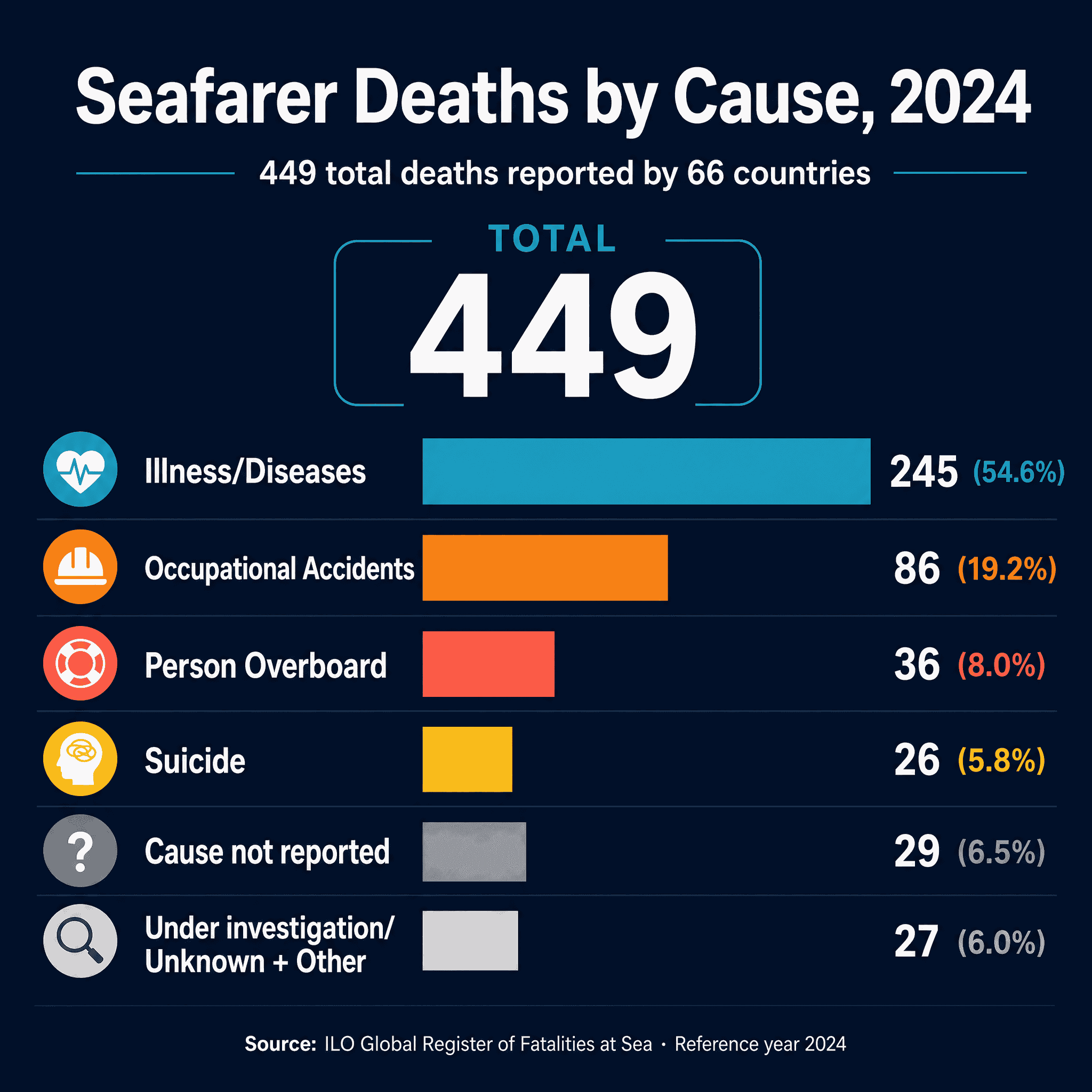
In 2024, 66 countries reported 449 seafarer deaths to the ILO. The single largest category was not what most safety systems are built to prevent. Health-related causes accounted for 245 deaths, well over half the total, many of them sudden illness including cardiovascular events. Occupational accidents, the falls, the mooring incidents, the cargo-handling injuries, accounted for 86.
So for every seafarer who died in the kind of accident a safety management system is designed to catch, nearly three died of something else. That gap is the story, and it runs directly through the conditions of the work.
The causes safety systems don't count
Maritime safety has spent decades building systems to prevent and record accidents. Those systems work, and the MLC has contributed to safer operations over its twenty years. But an accident-focused system measures a minority of what kills seafarers, and it is largely silent on the rest.
Health-related deaths at sea are not simply bad luck. Life aboard a vessel concentrates the exact conditions that drive cardiovascular disease over time: disrupted sleep from watch-keeping and night work, sustained stress, long periods away from family and ordinary support, limited exercise, and limited access to immediate medical care when something goes wrong. The ILO notes that delays in evacuation and the absence of on-board medical care can worsen health outcomes that might be survivable ashore. These are features of how maritime work is designed, not accidents in the conventional sense.
The two categories the ILO singles out for concern make the psychosocial dimension explicit. Persons overboard accounted for 36 deaths and suicides for 26. The ILO connects both not only to safety procedures but directly to fatigue, mental health and psychosocial risk, issues it notes have drawn increasing attention in recent years. When a UN agency names psychosocial risk as a factor in seafarer deaths, in its own official data, the question for operators is no longer whether these conditions matter. It is whether they are being managed.
What the breakdown tells operators
The detail beneath the headline figures is where the operational lessons sit.
By rank, ratings accounted for 44 per cent of reported deaths, and carried a higher share of both occupational accidents and suicides than officers. That pattern is consistent with what psychosocial research would predict. Ratings typically have less control over their work, less autonomy, and less voice than officers, and low control is one of the most reliable predictors of how badly demanding work affects a person. The hierarchy of the ship is also, in part, a hierarchy of exposure.
By department, health-related deaths made up a larger share among engine department personnel, while the proportion of suicides was higher among catering staff, though the ILO is careful to note the small numbers involved there. By age, 85 per cent of deaths involved seafarers aged 30 and above, consistent with health causes accumulating over a working life rather than striking at random.
None of this is visible through an accident-focused lens. A vessel could hold an excellent occupational-accident record and still be losing people to the conditions the record does not track. That is the same blind spot that makes recordable-injury metrics such poor predictors of serious harm, and the ILO data shows it playing out in the most final way possible.
The measurement gap is worst where the risk is highest
The most revealing part of the ILO's report is its honesty about its own limitations, because those limitations follow a telling pattern.
Of the reporting countries, 83 per cent cover occupational-accident deaths in their statistics. Only 59 per cent cover suicides. In other words, the maritime world's data systems are least reliable precisely where psychosocial risk shows up. The category most closely tied to mental health is the one least consistently recorded, which means the 26 reported suicides are likely an undercount, and the true psychosocial burden is larger than the official figure suggests.
This is not a criticism of the ILO, which is transparent about the gap and is working to close it. It is a description of a system that has historically measured what is easiest to count rather than what does the most harm. The same instinct that makes an organisation track recordable injuries while ignoring fatigue accumulation is the instinct that produces national statistics strong on accidents and weak on suicide. The measurement follows the mental model, and the mental model has been too narrow.
What this means for managing a crew
The practical implication is not that accident prevention matters less. It is that accident prevention, on its own, addresses a minority of what threatens seafarers, and that the larger share requires managing the conditions of the work itself.
That means treating fatigue, workload, isolation, and psychological safety as measurable operational risks rather than welfare afterthoughts. It means assessing the psychosocial conditions aboard with the same seriousness applied to physical hazards, which is what ISO 45003, the international standard for psychosocial risk, exists to structure. And it means paying particular attention to the groups the data flags: ratings, who carry disproportionate exposure, and the accumulation of health risk across a career rather than the isolated incident.
For operators with crews at sea, the ILO data is a clear signal. The conditions that produce the largest share of seafarer deaths are the conditions that psychosocial risk management is designed to address, and they sit almost entirely outside the accident-focused systems most vessels rely on. Closing that gap is not a welfare initiative. On this evidence, it is a matter of life.
If you are responsible for a maritime workforce and want to understand where your psychosocial risk actually sits, you can benchmark against the Six Drivers of Workplace Wellbeing using our self-assessment, or get in touch to discuss a psychosocial risk assessment aligned to ISO 45003. Our maritime page sets out how this applies to life at sea.
If you are a seafarer struggling with your mental health, support is available. ISWAN operates SeafarerHelp, a free, confidential, multilingual helpline available 24 hours a day, 365 days a year, at seafarerhelp.org.