Psychological Safety vs Psychosocial Risk: Two Different Things

Ask an operations director how the business manages psychosocial risk and there is a good chance the answer will be about psychological safety. We have run the training. Our supervisors have done the module. People know they can speak up.
It is a reasonable answer from someone who has been told the two things are the same. They are not, and the gap between them is where a lot of money gets spent on the wrong control.
Both terms describe something real and important. They come from different disciplines, they sit at different levels of the organisation, and only one of them carries a legal duty. Getting them straight changes what you buy, who you hold accountable, and whether any of it survives an audit.
What psychological safety actually is
Psychological safety is a construct from organisational behaviour research, developed by Amy Edmondson at Harvard in the late 1990s. It describes a shared belief held by members of a team that the team is a safe place for interpersonal risk. In plainer terms, whether people believe they can ask a question, admit an error, challenge a decision or raise a concern without being humiliated or punished for it.
Two features matter. It is a belief, which means it lives in perception rather than in policy. And it is a team-level property, not an organisational one. Two crews in the same company, under the same procedures, with the same handbook, will have very different levels of psychological safety, because the variable that moves it most is the behaviour of the person leading the team.
Edmondson's research came out of studying medical teams and error reporting. That origin still shapes it. Psychological safety is fundamentally about learning and about whether information travels upward before it becomes a problem.
What psychosocial risk actually is
Psychosocial risk comes from a completely different tradition. It sits inside occupational health and safety, alongside noise, dust, working at height and confined spaces. It is a class of hazard.
ISO 45003 describes psychosocial hazards as arising from how work is organised, from the social factors at work, and from the work environment and equipment. Rosters and shift patterns. Workload and pace. Role clarity. Job control. Supervision and support. Bullying, harassment and unresolved conflict. Job insecurity. Remote and isolated work.
These are conditions of work, and they exist whether or not anyone perceives them. A roster that gives a crew four hours of broken rest is a hazard on a night when everyone feels perfectly supported by their supervisor. The harm accumulates regardless of the climate.
Critically, psychosocial risk carries duties. Australia and a growing number of jurisdictions now require employers to identify and control psychosocial hazards under work health and safety regulation. Everywhere else, the general duty to provide a safe workplace covers psychological health whether or not a specific regulation names it. There is no equivalent legal obligation to have a psychologically safe team.
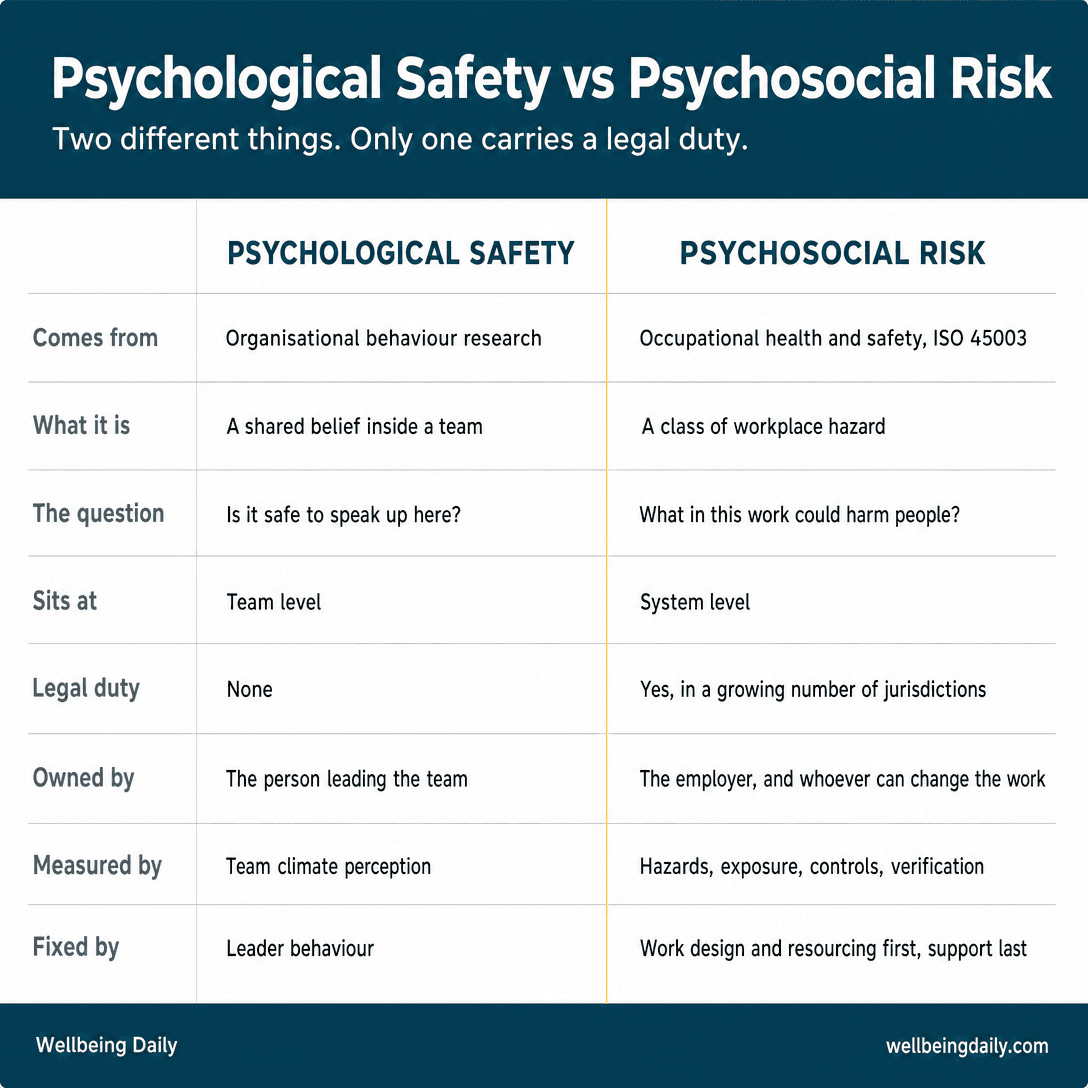
The comparison
Where it comes from. Psychological safety comes from organisational behaviour and team learning research. Psychosocial risk comes from occupational health and safety practice and standards, principally ISO 45003.
What it is. Psychological safety is a shared belief inside a team. Psychosocial risk is a class of workplace hazard.
The question it answers. Psychological safety asks whether it is safe to speak up here. Psychosocial risk asks what conditions in this work could harm people, and what controls them.
Where it sits. Psychological safety operates at team level and varies between crews in the same company. Psychosocial risk operates at system level, and is created by decisions about design, resourcing and structure.
Whether there is a duty. No jurisdiction requires an employer to produce psychological safety. A growing number require employers to identify and control psychosocial hazards, with codes of practice setting the expectation.
Who owns it. Psychological safety is owned by the person leading the team. Psychosocial risk is owned by the employer, with each control assigned to whoever has authority over the condition, which is often operations, commercial or planning rather than HR.
How it is measured. Psychological safety is measured through team climate perception. Psychosocial risk is managed through hazard identification, exposure assessment, a risk register, controls and verification.
What fixes it. Psychological safety improves through leader behaviour, how questions are received and what happens to the first person who raises something awkward. Psychosocial risk reduces through work design, resourcing and process, with training and individual support as the last line rather than the first.
Where they genuinely connect
None of this makes psychological safety a soft add-on. The two are linked in two specific ways, and both are worth naming precisely.
Low psychological safety is itself a psychosocial hazard condition. If people cannot raise a concern about a supervisor without going through that supervisor, that sits directly inside the ISO 45003 hazard categories under support, relationships and conflict management. It belongs on the register in its own right.
Psychological safety is also a control that makes other hazard management work. Hazard identification depends on people telling you what the job is really like. A crew that does not believe reporting is survivable will give you a clean set of returns and a register full of nothing. In that sense psychological safety is the condition that lets the rest of the system see itself.
What it cannot do is substitute. Psychological safety helps people talk about a hazard. It does not remove the hazard.
The expensive mistake
Here is the version I see most often. An organisation recognises it has a psychosocial risk obligation, buys psychological safety training for its supervisors, records the training in the management system, and treats the duty as discharged.
Two problems follow. The first is that training is an administrative control, near the bottom of the hierarchy, and administrative controls do not close hazards that were created by work design. If the hazard is a crewing shortfall, no amount of speak-up culture puts another person on the watch. An auditor will note that the control does not address the hazard, and they will be right.
The second problem is worse and it is a matter of trust. Teaching a crew to raise concerns while leaving in place the condition they would raise concerns about produces a predictable sequence. People speak up. Nothing changes, because nobody in the room has authority over the roster or the budget. People stop speaking up, and they do so with more cynicism than before the training ran. You have spent money to make reporting less likely.
Which one do you need
Both, in a particular order.
Deal with the hazards you already know about first, at the level of the hierarchy where they actually sit. Fix the roster, fund the crewing, change the contract term, build the escalation route that bypasses the supervisor. These are the controls that do the work.
Build psychological safety alongside it, and treat it as the mechanism that keeps your hazard picture honest rather than as the intervention itself. When leaders can respond to a concern by changing something, psychological safety grows without a training module, because the crew has evidence that speaking up is worth the risk.
Then measure both, separately, because they will tell you different things. A team can score well on psychological safety while working inside a badly designed job, and the crew will describe that job clearly and cheerfully to anyone who asks. The information is good. The work is still unsafe.
Frequently asked questions
Is psychological safety the same as psychosocial safety?
No, and the similar wording causes most of the confusion. Psychological safety is a team-level belief about whether it is safe to take interpersonal risks such as admitting an error or challenging a decision. Psychosocial safety refers to the management of psychosocial hazards, meaning the conditions of work that can cause psychological or physical harm. One is a climate. The other is a hazard management discipline with duties attached.
Does psychological safety training satisfy ISO 45003?
No. ISO 45003 expects an organisation to identify psychosocial hazards, assess the risk, apply controls at the appropriate level of the hierarchy, and verify that those controls work. Training is one administrative control among many. Presented as the whole response, it will not stand up to audit, particularly where the hazards concerned relate to workload, rostering or staffing.
Is there a legal duty to provide psychological safety?
Not as such. The duty that exists in a growing number of jurisdictions is to identify and control psychosocial hazards at work. Low psychological safety can form part of that picture, since barriers to raising concerns sit within the ISO 45003 hazard categories, but no regulator requires an employer to produce a particular team climate.
Can a team have high psychological safety and still be exposed to psychosocial risk?
Yes, and this combination is common in well-led crews inside badly designed operations. People speak freely, report honestly and support each other, while the roster, the workload or the resourcing continues to cause harm. Good team climate makes the exposure visible. It does not reduce it.
Who is responsible for psychological safety, and who is responsible for psychosocial risk?
Psychological safety is shaped mainly by the person leading the team, through how they respond when someone raises something inconvenient. Psychosocial risk is the employer's duty, and individual controls should be owned by whoever has authority over the condition. Assigning psychosocial hazards to HR by default is a common error, since HR rarely controls crewing levels, schedules or contract terms.
Where should an organisation start?
Start with the hazards, because they carry the duty and they cause the harm. Identify what in the work could hurt people, get it onto the existing risk register with named owners, and control it at the level where the condition was created. Build psychological safety alongside that work rather than instead of it.