Employee Wellbeing Survey vs Wellbeing Assessment: Which One Do You Actually Need?

A shipping company ran an employee wellbeing survey across its shore staff and fleet. The results came back strong. Engagement above benchmark, low reported stress, a healthy eNPS. Six months later an auditor asked to see how psychosocial hazards were identified, controlled and reviewed on board. The survey could not answer that question. It was never built to.
This is the most common measurement mistake in safety-critical industries. Organisations buy a survey when what they need is an assessment, or they buy an assessment when what they need is to hear from the workforce. The two instruments carry similar names and sit in the same budget line. They measure completely different objects.
What an employee wellbeing survey measures
A wellbeing survey is a self-report instrument. It goes to the workforce and asks people to describe their own experience of work. Do you have enough time to do your job safely? Does your supervisor notice good work? Can you raise a concern without it costing you?
What comes back is perception data at scale. It tells you what conditions feel like from inside the job, which is information no policy document will ever give you. A rig crew and a corporate function can sit under identical procedures and report entirely different realities.
The questionnaire at the centre of Wellbeing Daily's Six Drivers Organisational Diagnostic works this way. It runs to 83 items across roughly 15 to 20 minutes and covers overall wellbeing, the Six Drivers of workforce wellbeing, psychosocial risk exposure aligned to ISO 45003, and operational outcomes including retention intent, trust and productivity. Each driver scores 0 to 100 and lands in one of three bands: At Risk below 50, Monitor between 50 and 74, Strong at 75 and above. No group of fewer than five respondents is ever reported, so nobody can be identified from a breakdown.
The strength of a survey is coverage and honesty. The limit is that it captures perception at a moment in time. It will tell you that fatigue is biting on the night shift. It will not tell you whether your fatigue controls exist, whether they are documented, or whether anyone verifies that they work.
Why we call ours a diagnostic
A survey reports what people said. A diagnostic works out why they said it and what should change as a result. The questionnaire is one input. The Six Drivers Organisational Diagnostic adds leadership and manager interviews and a review of policy and work design, then reads all three sources against each other. What comes out is a prioritised roadmap rather than a scorecard.
The difference shows up fastest where the sources disagree. Managers describe a workload control that the documents confirm and the workforce has never seen operate. A survey records the low score. A diagnostic locates the break.
What a wellbeing assessment measures
An assessment evaluates the management system, not the mood. It asks a different question entirely: does this organisation identify, control, monitor and review psychosocial hazards in a way that would stand up to scrutiny.
Wellbeing Daily's Psychosocial Risk Assessment is completed by an HR, OHS or leadership representative rather than the workforce. That is deliberate. Only someone with sight of policy, records and governance can say whether psychosocial hazards reach the risk register, whether controls are verified, or whether any of it is reviewed at management level. A deckhand has no line of sight to that, and asking would produce noise. The trade-off is equally plain. A maturity score built from management self-report will read higher than reality, which is why it needs workforce data sitting beside it.
The instrument runs 64 questions across eight sections, takes 20 to 30 minutes, and scores six domains mapped clause by clause to ISO 45003. Maturity lands on a five-band scale from Critical through Inactive, Reactive and Active to Proactive. The output is a risk register and a hazard-to-control matrix, which is the format an auditor, a tender panel or a board risk committee expects to see.
This is evidence, not sentiment. It shows where control exists on paper, where it exists in practice, and where it does not exist at all. What it cannot do is tell you how the work actually feels to the person doing it at 0300 in an engine room.
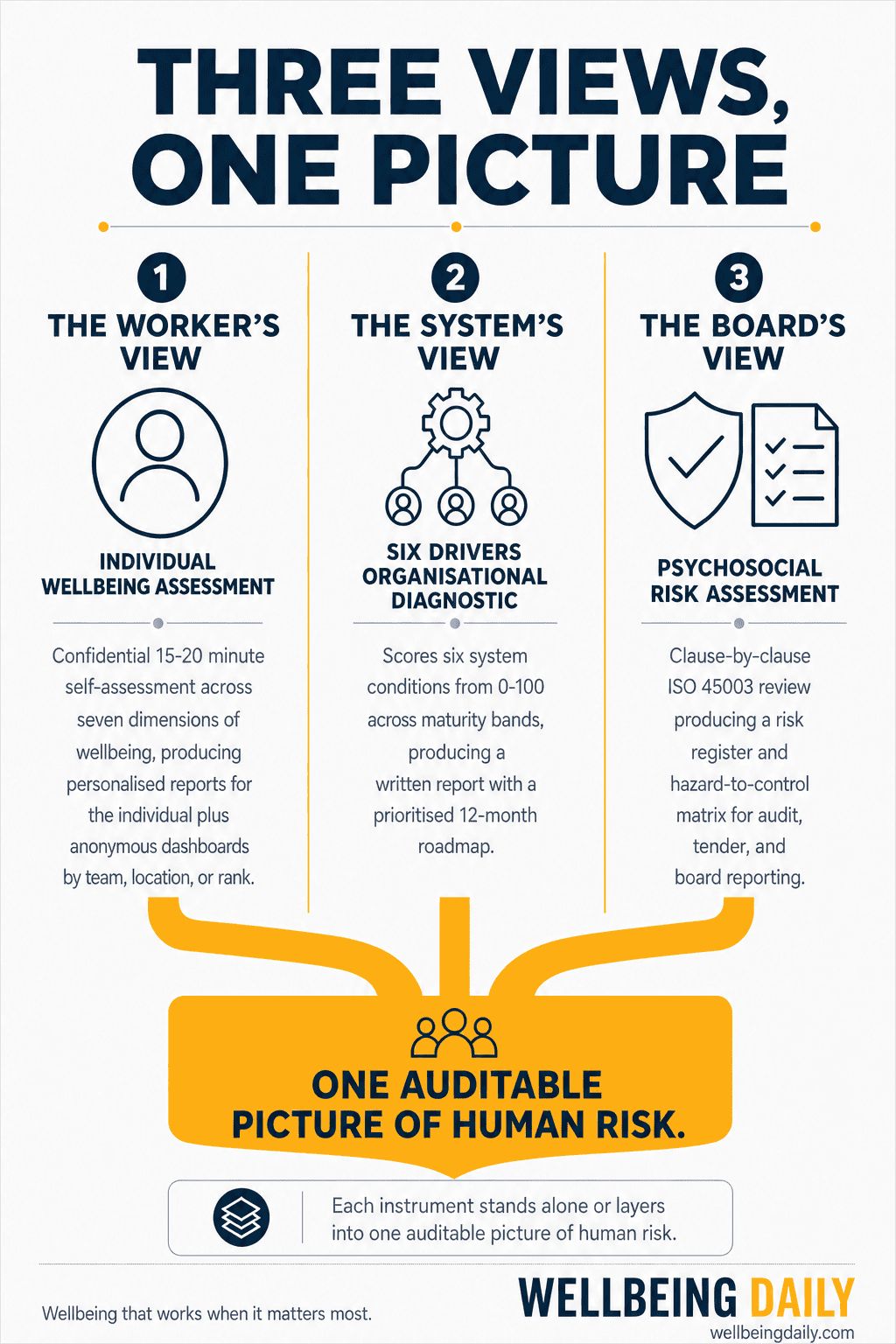
There is a third instrument worth naming, because it gets confused with both. The Individual Wellbeing Assessment is a confidential self-assessment across seven dimensions of personal wellbeing, and the individual receives their own report. The organisation only ever sees anonymised aggregates by team, location or rank. That instrument supports the person. It is not an organisational measurement tool and should never be sold as one.

Three views of the same risk
Put simply, the Individual Wellbeing Assessment is the worker's view. The Six Drivers Organisational Diagnostic is the system view from the inside. The Psychosocial Risk Assessment is the board's view. Each stands alone. Layered, they produce one auditable picture of human risk.
The interesting information sits in the gap between them. When a management system scores Active on paper and the workforce scores At Risk on work design, you have found something specific and fixable. The controls exist. They are not reaching the deck. That gap is far more useful than either number on its own, and it points at implementation rather than policy.
Which one do you need
If you have never measured, start with the workforce. You need to know where the pressure sits before you can decide what to control, and a questionnaire gives you a workforce-wide baseline in a fortnight. Run it as a diagnostic if you want to act on the result rather than file it. Running a compliance assessment first tends to produce a document that describes a system nobody has tested against reality.
If a regulator, a client, a tender or an insurer is asking for evidence, you need the assessment. A survey result is not a psychosocial risk assessment and presenting it as one will not survive a serious question. ISO 45003 asks you to demonstrate a process. Perception data is an input to that process, not a substitute for it.
If your obligation is compliance and your intent is improvement, you need both, and you need them read together. The diagnostic tells you what is happening and why. The assessment tells you whether your system is built to control it. Neither answers the other's question.
What measurement will not do
Neither instrument fixes anything. A score is a starting position, and the organisations that get value from measurement are the ones that treat the first report as the beginning of a work programme rather than the end of a compliance task.
Some of what surfaces will sit outside a wellbeing framework entirely. Crewing levels, rosters, pay, contract terms. An honest measurement process names those anyway, even when the lever belongs to someone else in the business. Anything less produces a comfortable report and an unchanged system.
One caution on the compliance side. ISO 45003 expects workers to take part in identifying the hazards that affect them, so a maturity score with no workforce data behind it is half an assessment. It records what the system claims. It cannot show whether the claim reaches the job.
Measure what people experience. Measure what the system controls. Then look hard at the distance between the two, because that distance is where the risk lives.